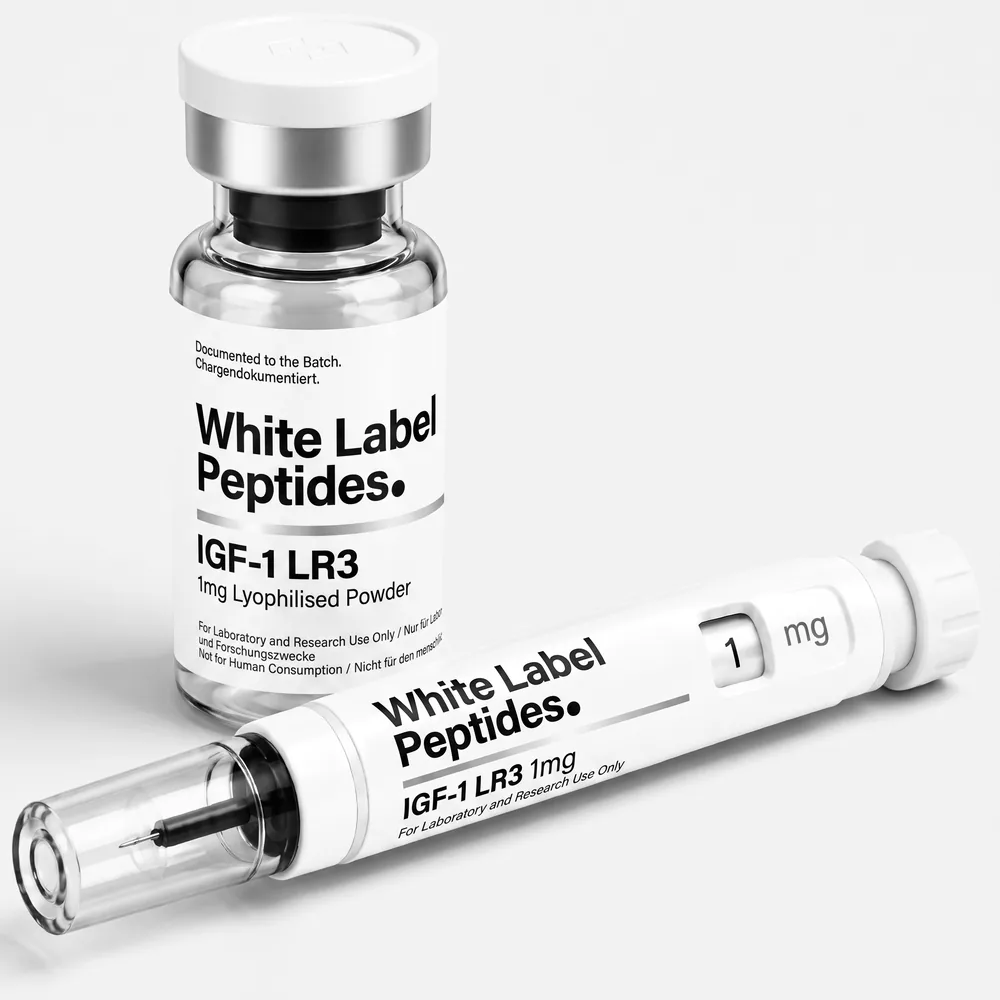
IGF-1 LR3
IGF-1 LR3, also written IGF 1 LR3, is supplied by White Label Peptides as a lyophilised powder in multi-dose vials, for laboratory and research use, to business buyers only. It sits in our performance category. Every batch is verified by HPLC and ships with its own Certificate of Analysis.
| Compound | IGF-1 LR3 |
|---|---|
| Full name | Long R3-IGF-1 (Insulin-like Growth Factor 1, Long Arg3) |
| Classification | Synthetic IGF-1 analogue |
| Peptide type | Recombinant 83-amino-acid protein |
| CAS number | 946870-92-4 |
| Molecular formula | C400H625N111O115S9 |
| Molecular weight | Approximately 9117.6 g/mol |
| Structure | 83-amino-acid analogue of IGF-1, with an arginine substitution for glutamic acid at position 3 and an additional 13-amino-acid N-terminal extension (relative to the 70-amino-acid native IGF-1) |
| Purity | ≥98% (HPLC-verified, batch-by-batch) |
| Form | Lyophilised peptide powder, multi-dose research vials |
| Appearance | White to off-white lyophilised powder prior to reconstitution |
| Presentation | Vials: 0.1 mg, 1 mg |
| Reconstitution | Reconstitute using bacteriostatic water or sterile laboratory-grade water |
| Storage | Store refrigerated at 2-8°C in a cool, dry environment away from direct light. For long-term storage prior to reconstitution, freezing conditions are recommended. Storage conditions are confirmed on the Certificate of Analysis supplied with each order. |
| Also written | IGF 1 LR3, IGF 1 LR3 peptide |
Specification data is provided for identification and procurement. It is not dosing guidance and it is not a claim of any effect.
Evidence and status
- Lab work
- Animal studies
- Human studies
- Approved label
Reviewed 2026-08-26. Regulatory status is stated for procurement and varies by market. It is not legal advice.
Research
What the published literature examined
This is an analogue, and the native IGF-1 literature does not transfer to it. The molecule was created in 1992 as an Escherichia coli expression construct: the glutamate at position 3 of human IGF-1 is replaced by arginine, and a 13-residue N-terminal extension is fused on, made of the first 11 amino acids of methionyl porcine growth hormone plus a Val-Asn dipeptide. Native IGF-1 is 70 residues, so this construct is 83. The 1992 papers measured protein synthesis, DNA synthesis and protein breakdown in rat L6 myoblasts along with binding-protein and receptor binding, concluding that the analogue's greater in-vitro potency comes from REDUCED binding to the IGF binding proteins rather than from increased receptor binding. In-vivo work exists but is in animals. A 2010 study at the German Sport University identified a histidine-tagged form in a seized injection vial and described it as a substance usually produced for biochemical studies.
What is not established
There is no human data on this analogue at all. The 2010 paper states it plainly: the effects of the histidine-tagged form in humans have not been elucidated or described. Nothing about its safety, pharmacokinetics, immunogenicity or biological effect in humans is established, and the extensive clinical record behind mecasermin says nothing about it.
What distinguishes IGF-1 LR3
IGF-1 LR3 is the only compound in this range whose near-namesake is an approved medicine while it is not. Mecasermin, the native 70-residue IGF-1, holds a US biologics licence and a European authorisation from 2007, and the two are routinely conflated. They are not the same molecule. The documented consequence of the substitution and the N-terminal extension is loss of binding-protein affinity, which is precisely the property that makes native-protein pharmacology non-transferable. It is also the only one here placed in WADA S2.3 rather than S2.2, and its provenance is a laboratory expression construct designed as a research reagent rather than a discontinued drug candidate.
Sources
- Francis GL et al. Novel recombinant fusion protein analogues of IGF-I. J Mol Endocrinol. 1992;8(3):213-23
- King R et al. Production and characterization of recombinant IGF-I and potent analogues with Gly or Arg substituted for Glu3. J Mol Endocrinol. 1992;8(1):29-41
- Kohler M et al. Detection of His-tagged Long-R3-IGF-I in a black market product. Growth Horm IGF Res. 2010;20(5):386-90
- European Medicines Agency. Increlex, EPAR, mecasermin, the native protein and not this compound
- World Anti-Doping Agency. 2026 Prohibited List, section S2.3
This page describes a compound as a material and summarises published research about it. It is for general and procurement information only. It is not medical advice, not a treatment recommendation, and not guidance on use. Supplied for laboratory and research use, not for human consumption.
Specification
About this compound
The specification below is the batch-independent data. Purity and analysis date vary by batch, so they appear on the certificate issued with your order rather than on this page.
What this compound is
IGF-1 LR3 in supply terms
IGF-1 LR3 (Long R3-IGF-1, CAS 946870-92-4) is a synthetic analogue of insulin-like growth factor 1, built as an 83-amino-acid recombinant protein with a molecular formula of C400H625N111O115S9 and a molecular weight of approximately 9117.6 g/mol. The analogue differs from native IGF-1, a 70-amino-acid protein, in two defined ways: an arginine residue in place of glutamic acid at position 3, and a 13-amino-acid extension added to the N-terminus. These two modifications account for the full difference between the 70-residue native sequence and the 83-residue analogue carried in this catalogue, and they are reflected directly in the higher molecular weight quoted above. Buyers comparing suppliers' technical sheets for this item should check that the quoted sequence length, substitution and molecular weight match this specification, since a shorter or unmodified IGF-1 listing is a different product. IGF-1 LR3 is supplied at >=98% purity (HPLC-verified, batch by batch) as a white to off-white lyophilised powder in multi-dose research vials, listed at a 1mg dosage strength. Reconstitute using bacteriostatic water or sterile laboratory-grade water. Store refrigerated at 2-8C in a cool, dry environment away from direct light; long-term storage prior to reconstitution should be under freezing conditions, confirmed on the Certificate of Analysis supplied with each order.
This section describes the compound as a material. It makes no claim about any effect and is not guidance on use.
What varies by batch
The page identifies the compound. The certificate records the batch.
Purity, method, analysis date and issuing party belong on the batch record rather than in page copy.
| Send the volume you need for IGF-1 LR3 and your delivery country. We will quote against it. | Request pricing |
Same category
Also in Performance
| Compound | Identifier | Presentation |
|---|---|---|
| Ipamorelin | C38H49N9O5 | Vials: 5 mg. Pre-filled pens: 5 mg |
| Tesamorelin | C221H366N72O67S | Vials: 5 mg. Pre-filled pens: 5 mg |
| CJC-1295 No DAC | C152H252N44O42 | Vials: 2 mg. Pre-filled pens: 5 mg |
| CJC-1295 with DAC | 446262-90-4 | Vials: 2 mg |
| GHRP-2 | 158861-67-7 | Vials: 5 mg |
| GHRP-6 | 87616-84-0 | Vials: 5 mg |
Questions
Supply, answered
Is IGF-1 LR3 available for private label?
Yes. It can be supplied under your own brand on the vial and the carton, with the Certificate of Analysis issued under your product name.
What is the minimum order quantity?
Set for this compound specifically and confirmed at the enquiry stage, before you commit.
What purity is supplied?
98 percent or higher, verified by HPLC. The certificate issued with your batch carries the actual figure for that batch.
How is it shipped?
As lyophilised powder in multi-dose vials, packed for transit. Delivery in 5 to 7 days once the batch is released.
We already buy IGF-1 LR3. Can you quote against our current volume?
Yes. Send the volume and the delivery country. Pricing is tiered per compound, so the quote reflects what you buy rather than a list price.
Can you supply IGF-1 LR3 as a second source?
Yes. Terms are agreed per compound, so you can add IGF-1 LR3 without moving anything else you buy elsewhere.
Request pricing for IGF-1 LR3
Indicative volume and delivery country is enough to start. We reply within one working day.