BPC-157
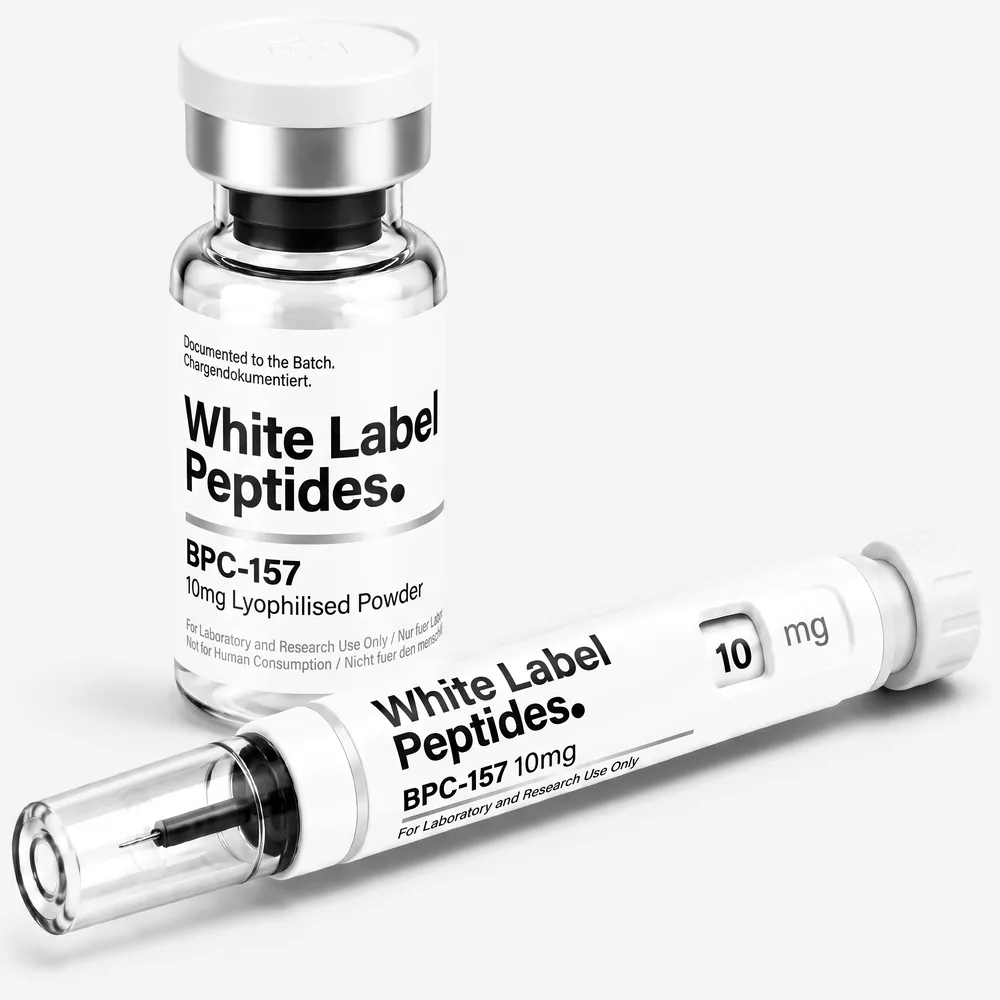
BPC-157, also written BPC 157, is supplied by White Label Peptides as a lyophilised powder in multi-dose vials, for laboratory and research use, to business buyers only. It sits in our recovery and repair category. Every batch is verified by HPLC and ships with its own Certificate of Analysis.
| Compound | BPC-157 |
|---|---|
| Full name | Body Protection Compound-157 |
| Classification | Gastric-Derived Protective Peptide Fragment |
| Peptide type | Synthetic Pentadecapeptide |
| Molecular formula | C62H98N16O22 |
| Molecular weight | Approximately 1419.5 g/mol |
| Sequence | GEPPPGKPADDAGLV |
| Form | Lyophilised powder (vials) or ready-to-use solution (pre-filled pens) |
| Appearance | White to off-white lyophilised powder prior to reconstitution |
| Presentation | Vials: 5 mg, 10 mg. Pre-filled pens: 10 mg |
| Reconstitution | Typically reconstituted using: Bacteriostatic water - Sterile laboratory-grade water |
| Storage | Store refrigerated at 2-8°C in a cool, dry environment away from direct sunlight. Long-term storage may require freezing conditions prior to reconstitution. |
| Also written | BPC 157, BPC 157 peptide |
Specification data is provided for identification and procurement. It is not dosing guidance and it is not a claim of any effect.
Evidence and status
- Lab work
- Animal studies
- Human studies
- Approved label
Reviewed 2026-08-26. Regulatory status is stated for procurement and varies by market. It is not legal advice.
Research
What the published literature examined
The non-clinical literature is dominated by rodent work: the FDA counted 24 articles describing in vivo and in vitro models, largely in Wistar rats, covering surgically created colonic fistulas, transected tendons, gastrointestinal and hepatic lesions, and rodent models of stroke, encephalopathy and spinal cord injury. Human data exist but are very thin. The FDA identified five clinical studies, of which the only randomised controlled one is a meeting abstract describing 53 subjects with mild to moderate ulcerative colitis randomised to an 80 mg enema or placebo for two weeks, with 46 completers and a between-group disease activity difference of 1.6 points on a confidence interval spanning zero. One phase 1 study is registered and one phase 2 study in acute hamstring strain began recruiting on 2 February 2026 with no results posted. In two rectal studies the compound was not detected in plasma.
What is not established
There is no established human pharmacokinetic profile by any route other than rectal, and no published full-text randomised controlled study for any indication. The FDA judged both the free base and the acetate not well characterised physically and chemically, citing absent data on peptide-related impurities, aggregates, bioburden, bacterial endotoxins and particle size.
What distinguishes BPC-157
The name is a common name rather than an adopted one, and the FDA records encountering multiple salts and derivatives with DIFFERENT active moieties sold commercially under that single name, which the agency states is itself a safety risk because a buyer may receive a different substance from the one specified. The compound is described in the literature only as a pentadecapeptide fragment of body protection compound, a protein reported from gastric juice in 1993, so its identity rests on a parent whose own characterisation is not documented. Contrast AOD-9604, whose parent is an approved biologic, and LL-37, whose parent is a defined human gene product.
Sources
- US FDA. Briefing document, Pharmacy Compounding Advisory Committee, evaluation of BPC-157-related bulk drug substances, 11 May 2026
- US FDA. Meeting of the Pharmacy Compounding Advisory Committee, 23 and 24 July 2026
- US FDA. Certain bulk drug substances for use in compounding that may present significant safety risks
- World Anti-Doping Agency. 2026 Prohibited List, section S0
- ClinicalTrials.gov. NCT02637284, phase 1 safety and pharmacokinetics
This page describes a compound as a material and summarises published research about it. It is for general and procurement information only. It is not medical advice, not a treatment recommendation, and not guidance on use. Supplied for laboratory and research use, not for human consumption.
Specification
About this compound
The specification below is the batch-independent data. Purity and analysis date vary by batch, so they appear on the certificate issued with your order rather than on this page.
What this compound is
BPC-157 in supply terms
BPC-157 is a synthetic pentadecapeptide, a 15-residue chain with the sequence GEPPPGKPADDAGLV, molecular formula C62H98N16O22 and a molecular weight of approximately 1419.5 g/mol. It corresponds to a fragment of a larger gastric-origin sequence, which is the basis for its catalogue classification as a gastric-derived peptide fragment, a naming convention tied to sequence origin rather than a statement about the compound. The compound is supplied as a lyophilised powder in multi-dose research vials for injectable research format, white to off-white in appearance prior to reconstitution. Standard fill is 10mg per vial. Reconstitution is typically carried out with bacteriostatic water or sterile laboratory-grade water, consistent with the rest of the peptide fragment range. Storage requires refrigeration at 2-8C, kept away from direct sunlight, with freezing conditions recommended for extended storage periods prior to reconstitution. As a short-chain fragment rather than a full protein, BPC-157 sits at the lighter end of the molecular weight range in this catalogue, a relevant data point when specifying comparable volumes or concentrations against larger peptides. Buyers should confirm batch documentation and Certificate of Analysis details directly against the order rather than relying on catalogue defaults, since fill weight and reconstitution volume determine final concentration.
This section describes the compound as a material. It makes no claim about any effect and is not guidance on use.
What varies by batch
The page identifies the compound. The certificate records the batch.
Purity, method, analysis date and issuing party belong on the batch record rather than in page copy.
| Send the volume you need for BPC-157 and your delivery country. We will quote against it. | Request pricing |
Same category
Also in Recovery and Repair
| Compound | Identifier | Presentation |
|---|---|---|
| BPC-157 + TB-500 (Wolverine Stack) | On request | Vials: 5+5 mg, 10+10 mg. Pre-fi... |
| KPV | 67727-97-3 | Pre-filled pens: 10 mg |
| LL-37 | 597562-32-8 | Vials: 10 mg. Pre-filled pens: ... |
| TB-500 | C212H350N56O78S | Vials: 2 mg, 5 mg, 10 mg. Pre-f... |
Questions
Supply, answered
Is BPC-157 available for private label?
Yes. It can be supplied under your own brand on the vial and the carton, with the Certificate of Analysis issued under your product name.
What is the minimum order quantity?
Set for this compound specifically and confirmed at the enquiry stage, before you commit.
What purity is supplied?
98 percent or higher, verified by HPLC. The certificate issued with your batch carries the actual figure for that batch.
How is it shipped?
As lyophilised powder in multi-dose vials, packed for transit. Delivery in 5 to 7 days once the batch is released.
We already buy BPC-157. Can you quote against our current volume?
Yes. Send the volume and the delivery country. Pricing is tiered per compound, so the quote reflects what you buy rather than a list price.
Can you supply BPC-157 as a second source?
Yes. Terms are agreed per compound, so you can add BPC-157 without moving anything else you buy elsewhere.
Request pricing for BPC-157
Indicative volume and delivery country is enough to start. We reply within one working day.