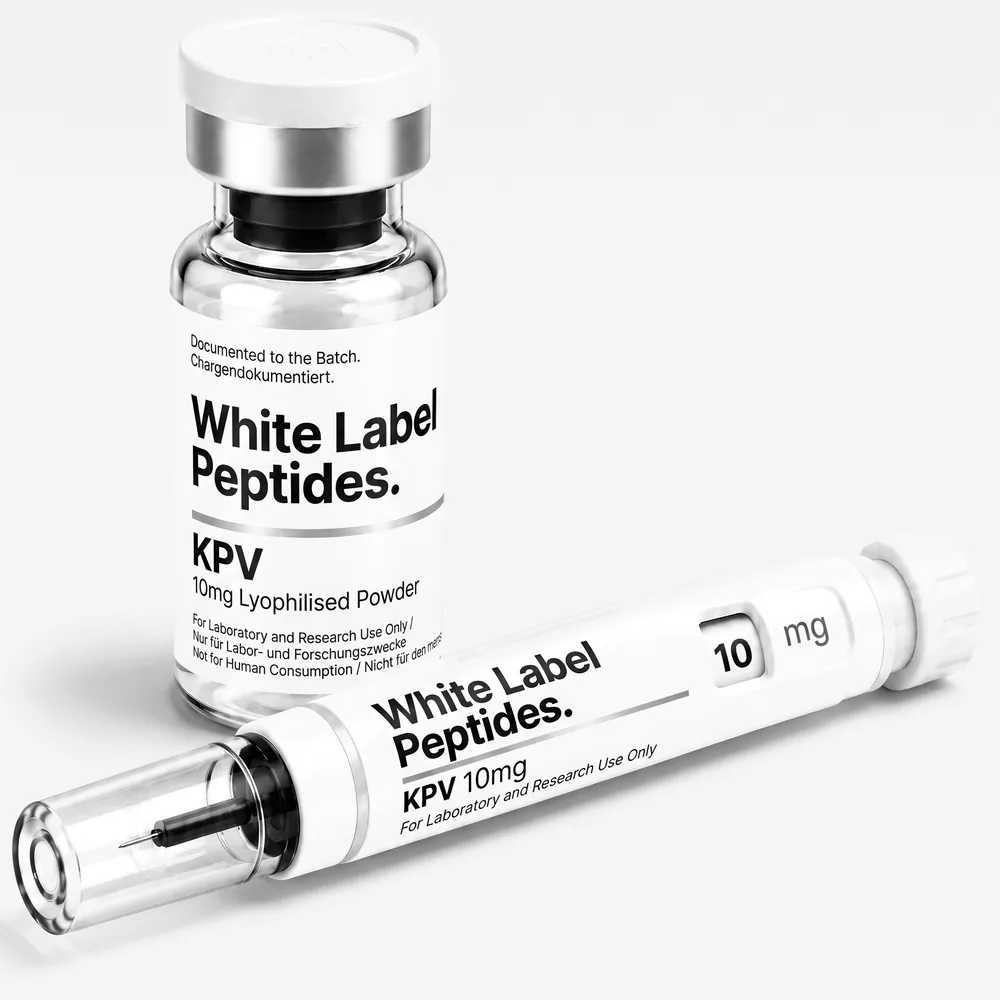
KPV
KPV is supplied by White Label Peptides as a lyophilised powder in multi-dose vials, for laboratory and research use, to business buyers only. It sits in our recovery and repair category. Every batch is verified by HPLC and ships with its own Certificate of Analysis.
| Compound | KPV |
|---|---|
| Also known as | alpha-MSH (11-13) |
| Synonyms | alpha-MSH (11-13) |
| Classification | Melanocortin-derived peptide fragment |
| Peptide type | Synthetic tripeptide |
| CAS number | 67727-97-3 |
| Molecular formula | C16H30N4O4 |
| Molecular weight | Approximately 342.44 g/mol |
| Sequence | Lys-Pro-Val (KPV) |
| Structure | C-terminal tripeptide fragment (residues 11-13) of alpha-melanocyte-stimulating hormone (α-MSH) |
| Purity | ≥98% (HPLC-verified, batch-by-batch) |
| Form | Ready-to-use solution in pre-filled pens |
| Appearance | White to off-white lyophilised powder prior to reconstitution |
| Presentation | Pre-filled pens: 10 mg |
| Reconstitution | Soluble in water; reconstitute using bacteriostatic water or sterile laboratory-grade water |
| Storage | Store refrigerated at 2-8°C in a cool, dry environment away from direct light. For long-term storage prior to reconstitution, freezing conditions are recommended. Storage conditions are confirmed on the Certificate of Analysis supplied with each order. |
Specification data is provided for identification and procurement. It is not dosing guidance and it is not a claim of any effect.
Evidence and status
- Lab work
- Animal studies
- Human studies
- Approved label
Reviewed 2026-08-26. Regulatory status is stated for procurement and varies by market. It is not legal advice.
Research
What the published literature examined
Published work is predominantly rodent in-vivo and cultured-cell in-vitro. A 2008 study administered KPV in two chemically induced murine colitis models and recorded body weight, histological infiltrate and cytokine expression. A second 2008 study examined uptake via the di/tripeptide transporter PepT1 in human intestinal epithelial cell lines and in murine colitis models. A 2003 study compared core alpha-MSH peptides against the C-terminal KPV tripeptide in murine inflammation assays and tested whether melanocortin receptors MC2, MC3 and MC4 were involved. Further rodent corneal and skin wound-model work is cited in the FDA evaluation.
What is not established
There is no human data. An FDA search of the published literature and of FAERS through December 2025 identified no clinical study, no human pharmacokinetic or pharmacodynamic data, and no human exposure data by any route. ClinicalTrials.gov holds no registered study for the term. No pharmacokinetic or toxicokinetic study exists in any species.
What distinguishes KPV
KPV is an endogenous human sequence rather than a synthetic construct: it is the naturally occurring C-terminal 11-13 fragment of alpha-melanocyte-stimulating hormone. Unusually, the mechanistic literature indicates it does not act through its parent's receptors. In vitro it failed to displace radiolabelled alpha-MSH from rat brain tissue, murine melanoma cells or MC1R-expressing macrophages, and unlike alpha-MSH it did not raise cyclic AMP in those macrophages. This matters when reading the literature: in the 503A nomination package, eight of the nine supporting references concerned alpha-MSH or other melanocortin derivatives rather than KPV itself.
Sources
- US FDA. Briefing document, Pharmacy Compounding Advisory Committee: evaluation of KPV-related bulk drug substances, 12 May 2026
- Dalmasso G et al. PepT1-mediated tripeptide KPV uptake reduces intestinal inflammation. Gastroenterology. 2008;134(1):166-78
- Kannengiesser K et al. Melanocortin-derived tripeptide KPV has anti-inflammatory potential in murine models of inflammatory bowel disease. Inflamm Bowel Dis. 2008;14(3):324-31
- Getting SJ et al. Dissection of the anti-inflammatory effect of the core and C-terminal (KPV) alpha-MSH peptides. J Pharmacol Exp Ther. 2003;306(2):631-7
- World Anti-Doping Agency. 2026 Prohibited List, section S0
This page describes a compound as a material and summarises published research about it. It is for general and procurement information only. It is not medical advice, not a treatment recommendation, and not guidance on use. Supplied for laboratory and research use, not for human consumption.
Specification
About this compound
The specification below is the batch-independent data. Purity and analysis date vary by batch, so they appear on the certificate issued with your order rather than on this page.
What this compound is
KPV in supply terms
KPV is registered under CAS 67727-97-3, a synthetic tripeptide with the sequence Lysine-Proline-Valine, molecular formula C16H30N4O4 and a molecular weight of approximately 342.44 g/mol, one of the smallest molecules in the catalogue by mass. It corresponds to the C-terminal three residues, positions 11 through 13, of alpha-melanocyte-stimulating hormone, and is catalogued under the alternative designation alpha-MSH (11-13). The classification, melanocortin-derived peptide fragment, describes its sequence origin rather than any claim about the compound. Purity is verified at 98 percent or higher by HPLC on a batch-by-batch basis. KPV ships as a lyophilised powder in multi-dose research vials, white to off-white in appearance, standard fill 10mg. It is freely soluble in water and typically reconstituted using bacteriostatic water or sterile laboratory-grade water, requiring less handling consideration around solubility than some larger peptides in the range. Storage calls for refrigeration at 2-8C, away from direct light, with freezing recommended for extended storage ahead of reconstitution. Certificate of Analysis documentation is issued with each order and confirms both the purity result and the storage window under which that result was validated. Given its small size relative to other short-chain peptides in the catalogue, buyers should compare unit pricing on a per-mg basis rather than per-vial when benchmarking against larger fragment peptides.
This section describes the compound as a material. It makes no claim about any effect and is not guidance on use.
What varies by batch
The page identifies the compound. The certificate records the batch.
Purity, method, analysis date and issuing party belong on the batch record rather than in page copy.
| Send the volume you need for KPV and your delivery country. We will quote against it. | Request pricing |
Same category
Also in Recovery and Repair
| Compound | Identifier | Presentation |
|---|---|---|
| BPC-157 | C62H98N16O22 | Vials: 5 mg, 10 mg. Pre-filled ... |
| BPC-157 + TB-500 (Wolverine Stack) | On request | Vials: 5+5 mg, 10+10 mg. Pre-fi... |
| LL-37 | 597562-32-8 | Vials: 10 mg. Pre-filled pens: ... |
| TB-500 | C212H350N56O78S | Vials: 2 mg, 5 mg, 10 mg. Pre-f... |
Questions
Supply, answered
Is KPV available for private label?
Yes. It can be supplied under your own brand on the vial and the carton, with the Certificate of Analysis issued under your product name.
What is the minimum order quantity?
Set for this compound specifically and confirmed at the enquiry stage, before you commit.
What purity is supplied?
98 percent or higher, verified by HPLC. The certificate issued with your batch carries the actual figure for that batch.
How is it shipped?
As lyophilised powder in multi-dose vials, packed for transit. Delivery in 5 to 7 days once the batch is released.
We already buy KPV. Can you quote against our current volume?
Yes. Send the volume and the delivery country. Pricing is tiered per compound, so the quote reflects what you buy rather than a list price.
Can you supply KPV as a second source?
Yes. Terms are agreed per compound, so you can add KPV without moving anything else you buy elsewhere.
Request pricing for KPV
Indicative volume and delivery country is enough to start. We reply within one working day.