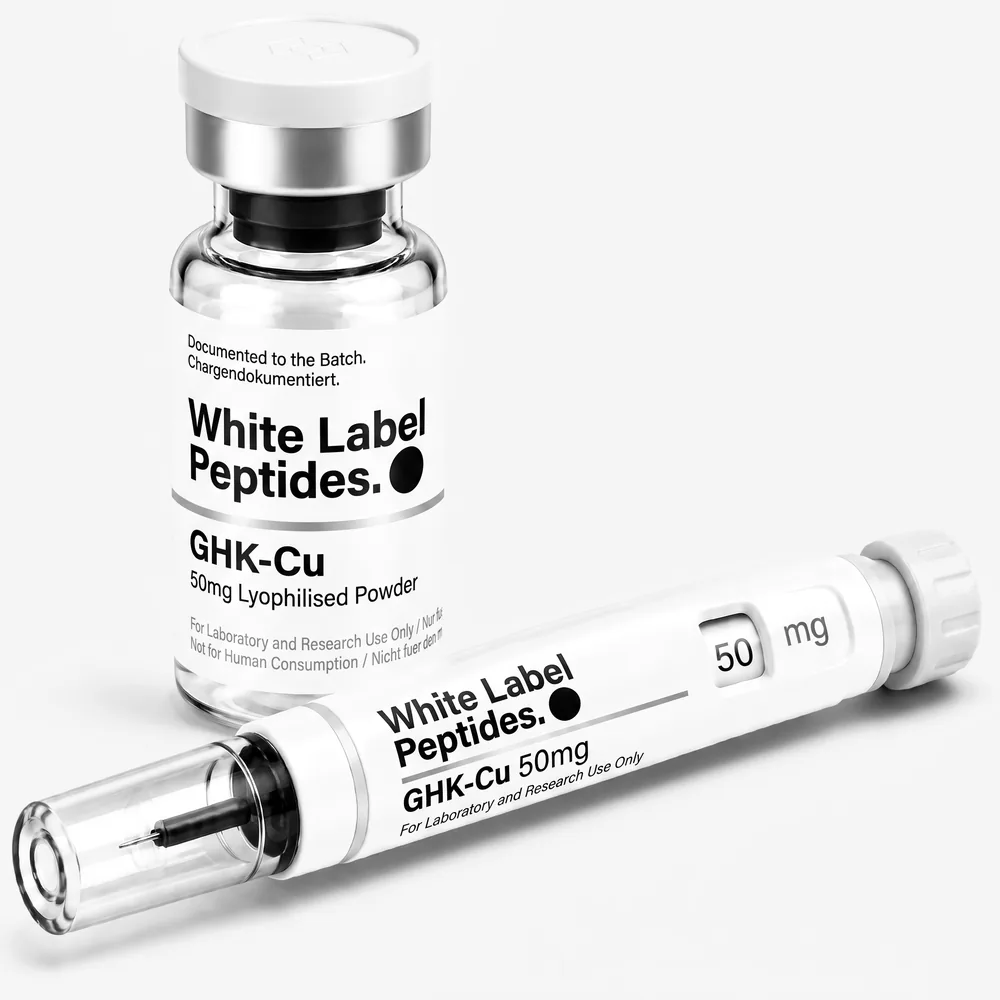
GHK-Cu
GHK-Cu, also written GHK Cu, is supplied by White Label Peptides as a lyophilised powder in multi-dose vials, for laboratory and research use, to business buyers only. It sits in our beauty category. Every batch is verified by HPLC and ships with its own Certificate of Analysis.
| Compound | GHK-Cu |
|---|---|
| Full name | Glycyl-L-Histidyl-L-Lysine Copper |
| Peptide type | Copper Peptide Complex |
| Molecular formula | C14H24N6O4Cu |
| Molecular weight | Approximately 340.9 g/mol |
| Sequence | Glycine - Histidine - Lysine bound to Copper (Cu²⁺) |
| Form | Lyophilised powder (vials) or ready-to-use solution (pre-filled pens) |
| Appearance | Blue lyophilised powder after synthesis due to copper binding properties. |
| Presentation | Vials: 50 mg, 100 mg. Pre-filled pens: 50 mg, 100 mg |
| Reconstitution | Typically reconstituted using: Bacteriostatic water Sterile laboratory-grade water |
| Storage | Store refrigerated at 2-8°C in a cool, dry environment away from direct sunlight. Long-term storage may require freezing conditions prior to reconstitution. |
| Also written | GHK Cu, GHK Cu peptide |
Specification data is provided for identification and procurement. It is not dosing guidance and it is not a claim of any effect.
Evidence and status
- Lab work
- Animal studies
- Human studies
- Approved label
Reviewed 2026-08-26. Regulatory status is stated for procurement and varies by market. It is not legal advice.
Research
What the published literature examined
The controlled literature is dominated by in-vitro and rodent work: activity has been studied in cultured human fibroblasts and keratinocytes, in gene-expression profiling, and in rodent models of skin and connective-tissue repair, with a substantial review literature framing it as a modulator of cellular pathways in skin regeneration. Roughly 80 records exist under this name and about 25 under copper tripeptide, and the majority are mechanistic, review or cosmetic-science articles rather than controlled clinical studies. Verified controlled human interventional evidence is essentially absent: the one registered study specific to the compound is a phase 2 randomised study of a topical gel against vehicle in 60 estimated participants, which began recruiting on 2 February 2026 and has posted no results. Remaining human context is observational, since the tripeptide is present endogenously in plasma.
What is not established
No completed controlled human study with published results was identified for any indication or route. The FDA states there are limited human data to inform safety considerations for injectable use, and flags aggregation and peptide-related impurities as the specific unresolved quality questions for that route.
What distinguishes GHK-Cu
It is not a pure peptide but a metal-coordination complex: a three-residue peptide chelating a copper ion, which makes copper content and copper speciation quality attributes that simply do not exist for the other compounds here. At three residues it is by far the shortest, against fifteen, sixteen and thirty-seven for its neighbours. Commercially the decisive fact is the split in its regulatory identity: it holds a settled cosmetic-ingredient position while having no medicinal authorisation anywhere, and its FDA listing is uniquely qualified for injectable routes, where the entries for the others carry no route limitation.
Sources
- US FDA. Certain bulk drug substances for use in compounding that may present significant safety risks, GHK-Cu entry, injectable routes
- Pickart L, Margolina A. Regenerative and protective actions of the GHK-Cu peptide in the light of the new gene data. Int J Mol Sci. 2018;19(7):1987
- Pickart L et al. GHK peptide as a natural modulator of multiple cellular pathways in skin regeneration. Biomed Res Int. 2015;2015:648108
- ClinicalTrials.gov. NCT07437586, phase 2 randomised study of a topical gel against vehicle, recruiting from 2 February 2026
- World Anti-Doping Agency. 2026 Prohibited List, searched in full with no occurrence of GHK, GHK-Cu or copper tripeptide
This page describes a compound as a material and summarises published research about it. It is for general and procurement information only. It is not medical advice, not a treatment recommendation, and not guidance on use. Supplied for laboratory and research use, not for human consumption.
Specification
About this compound
The specification below is the batch-independent data. Purity and analysis date vary by batch, so they appear on the certificate issued with your order rather than on this page.
What this compound is
GHK-Cu in supply terms
GHK-Cu is a tripeptide of glycine, histidine and lysine coordinated to a copper(II) ion, giving the formula C14H24N6O4Cu and a molecular weight near 340.9 g/mol. The copper is not a contaminant or an additive; it is bound directly into the molecule through coordination bonds involving the histidine imidazole ring and the peptide's terminal amine and carboxylate groups, which is also why the lyophilised powder presents as blue rather than the white or off-white typical of unbound peptides. The tripeptide sequence occurs naturally, and GHK-Cu is also listed on the EU's cosmetic ingredient inventory (CosIng), a regulatory classification that determines how the compound can be labelled and traded within EU cosmetic supply chains, separate from its listing here as a research compound. It ships as a lyophilised powder in multi-dose vials at 50mg or 100mg fill weights, reconstituted with bacteriostatic water or sterile laboratory-grade water. Store at 2-8C, away from direct sunlight, with freezing recommended for longer-term storage prior to reconstitution. Because the copper content adds measurable mass to the tripeptide backbone, buyers comparing this listing to unbound GHK quotes should confirm which molecular weight a supplier is pricing against, the copper complex or the free tripeptide.
This section describes the compound as a material. It makes no claim about any effect and is not guidance on use.
What varies by batch
The page identifies the compound. The certificate records the batch.
Purity, method, analysis date and issuing party belong on the batch record rather than in page copy.
| Send the volume you need for GHK-Cu and your delivery country. We will quote against it. | Request pricing |
Same category
Also in Beauty
| Compound | Identifier | Presentation |
|---|---|---|
| Glow (BPC-157 + TB-500 + GHK-Cu) | On request | Vials: 10+10+50 mg. Pre-filled ... |
| Glutathione | 70-18-8 | Vials: 1500 mg. Pre-filled pens... |
| Melanotan II (MT-2) | 121062-08-6 | Vials: 10 mg. Pre-filled pens: ... |
Questions
Supply, answered
Is GHK-Cu available for private label?
Yes. It can be supplied under your own brand on the vial and the carton, with the Certificate of Analysis issued under your product name.
What is the minimum order quantity?
Set for this compound specifically and confirmed at the enquiry stage, before you commit.
What purity is supplied?
98 percent or higher, verified by HPLC. The certificate issued with your batch carries the actual figure for that batch.
How is it shipped?
As lyophilised powder in multi-dose vials, packed for transit. Delivery in 5 to 7 days once the batch is released.
We already buy GHK-Cu. Can you quote against our current volume?
Yes. Send the volume and the delivery country. Pricing is tiered per compound, so the quote reflects what you buy rather than a list price.
Can you supply GHK-Cu as a second source?
Yes. Terms are agreed per compound, so you can add GHK-Cu without moving anything else you buy elsewhere.
Request pricing for GHK-Cu
Indicative volume and delivery country is enough to start. We reply within one working day.